In today’s fast-paced digital economy, businesses are inundated with data from multiple sources, each requiring seamless integration and actionable insights. This is where SSIS-469 comes into play—a powerful solution designed to streamline data management, enhance business intelligence, and support informed decision-making. For startup founders, tech entrepreneurs, and enterprise professionals, understanding SSIS-469 is no longer optional; it is essential for building data-driven organizations.
SSIS-469 is not just a tool—it represents a strategic framework for handling complex data workflows. By enabling efficient extraction, transformation, and loading (ETL) processes, it ensures that businesses can convert raw data into meaningful intelligence. In a landscape where speed, accuracy, and scalability define success, SSIS-469 offers a competitive edge.
What is SSIS-469?
SSIS-469 refers to a specialized module within the broader SQL Server Integration Services (SSIS) framework, tailored for complex data integration and workflow automation. It is engineered to handle large-scale data operations, enabling organizations to consolidate information from diverse databases, cloud platforms, and applications.
Unlike traditional data management tools, SSIS-469 emphasizes performance optimization, error handling, and real-time analytics. It is particularly beneficial for companies that need to integrate multiple data streams, such as sales records, customer interactions, and operational metrics, into a unified system.
For tech professionals, mastering SSIS-469 is an opportunity to reduce data silos, improve reporting accuracy, and deliver actionable insights more efficiently.
Key Features of SSIS-469
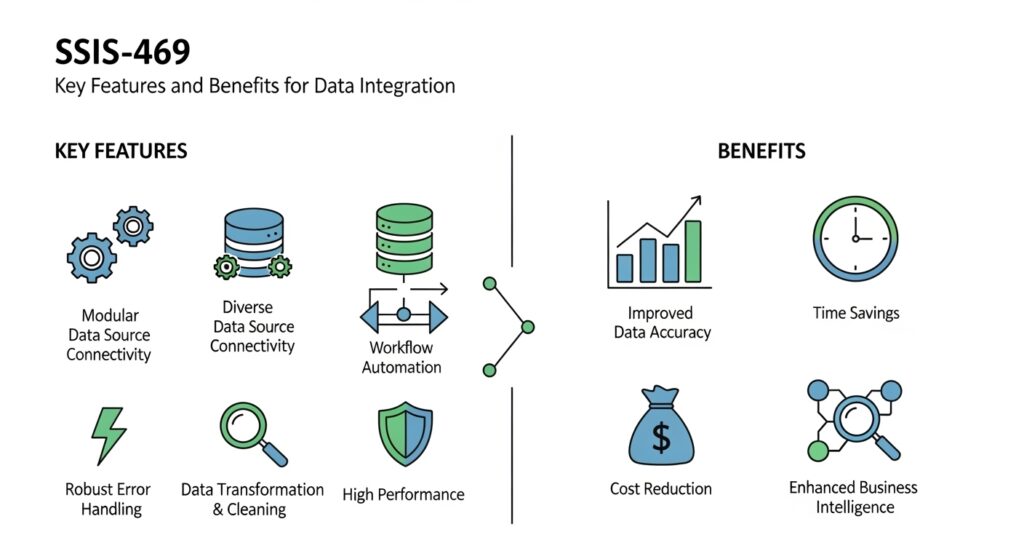
SSIS-469 stands out due to its comprehensive functionality and adaptability. Some of its core features include:
- Advanced ETL Capabilities: Streamline extraction, transformation, and loading of data from various sources.
- Error Handling and Logging: Built-in mechanisms for tracking, managing, and resolving errors.
- Real-Time Processing: Supports near-instantaneous data integration for timely decision-making.
- Scalability: Efficiently handles large datasets, making it suitable for both startups and enterprises.
- Custom Workflow Automation: Automates routine tasks, freeing up human resources for strategic initiatives.
These features make SSIS-469 an indispensable tool for organizations aiming to leverage data as a strategic asset.
Benefits of Implementing SSIS-469
Implementing SSIS-469 offers a range of benefits that extend beyond operational efficiency:
- Improved Decision-Making: Consolidated and accurate data empowers executives to make informed choices.
- Operational Efficiency: Automation of repetitive tasks reduces manual workload and errors.
- Cost Optimization: Streamlined processes decrease resource wastage and IT overhead.
- Enhanced Data Quality: Built-in validation ensures consistency, reliability, and accuracy.
- Scalability: Adapts to business growth without requiring a complete overhaul of data systems.
For startup founders and entrepreneurs, these advantages translate into faster insights, more reliable analytics, and a foundation for scaling operations.
SSIS-469 in Real-World Applications
The versatility of SSIS-469 allows it to be applied across multiple industries. For example:
- E-Commerce: Integrating customer data, inventory, and sales for personalized marketing campaigns.
- Healthcare: Consolidating patient records and clinical data for improved treatment decisions.
- Finance: Automating reporting, risk analysis, and compliance tracking.
- Manufacturing: Monitoring supply chain, production, and inventory metrics in real-time.
By providing seamless integration across different datasets, SSIS-469 enables businesses to operate more cohesively and strategically.
Comparison: SSIS-469 vs Traditional Data Integration
| Aspect | Traditional ETL Tools | SSIS-469 |
| Data Handling | Limited volume and speed | High-volume, optimized for performance |
| Error Management | Basic logging | Advanced error tracking and resolution |
| Automation | Manual or semi-automated | Fully automated workflows |
| Integration Flexibility | Limited connectors | Wide range of connectors for multiple sources |
| Real-Time Processing | Rarely supported | Supported for near real-time analytics |
| Scalability | Moderate | Highly scalable for growing datasets |
This table demonstrates why SSIS-469 is increasingly preferred in modern enterprises where data complexity and volume are significant challenges.
How SSIS-469 Enhances Business Intelligence
Business intelligence (BI) relies on accurate and timely data. SSIS-469 enhances BI initiatives by ensuring that data pipelines are robust, consistent, and efficient. When combined with visualization tools like Power BI or Tableau, the insights derived from SSIS-469 can drive strategy, identify growth opportunities, and anticipate market trends.
For example, retail companies can use SSIS-469 to integrate sales and inventory data, enabling predictive restocking and optimized supply chain management. Financial institutions can consolidate transactional data to detect anomalies or streamline regulatory reporting. The possibilities are expansive and industry-specific.
Challenges and Considerations
Despite its strengths, adopting SSIS-469 requires careful planning. Common challenges include:
- Initial Setup Complexity: Implementing SSIS-469 may require expertise in SQL Server and ETL workflows.
- Ongoing Maintenance: Continuous monitoring and optimization are necessary to maintain performance.
- Data Security: Sensitive information must be safeguarded during integration processes.
- Cost Considerations: Licensing and infrastructure may pose initial financial investment.
Addressing these challenges with strategic planning, skilled personnel, and cloud-based solutions ensures that organizations maximize the benefits of SSIS-469.
Strategies for Maximizing SSIS-469 Impact
Startups and enterprises can adopt several strategies to fully leverage SSIS-469:
- Invest in Training: Ensure technical teams are proficient in SSIS-469 best practices.
- Integrate with BI Tools: Connect SSIS-469 workflows to visualization and analytics platforms for actionable insights.
- Automate Data Governance: Implement validation, auditing, and security protocols within SSIS-469 processes.
- Monitor and Optimize Pipelines: Regular performance assessments prevent bottlenecks and ensure scalability.
By strategically implementing these measures, businesses can turn SSIS-469 into a cornerstone of their data strategy.
Future of SSIS-469 in Data Management
As enterprises increasingly rely on data-driven decision-making, the role of tools like SSIS-469 will continue to grow. Integration with cloud computing, AI-driven data analytics, and real-time processing will enhance its capabilities further.
For startup founders, embracing SSIS-469 today provides a competitive edge in developing intelligent, scalable, and adaptable data ecosystems. Organizations that master SSIS-469 will be positioned to respond rapidly to market shifts and capitalize on emerging opportunities.
Conclusion: SSIS-469 as a Catalyst for Data-Driven Success
SSIS-469 represents more than just a data integration tool; it is a strategic enabler for modern enterprises. By combining advanced ETL capabilities, real-time analytics, and automation, it empowers businesses to transform raw data into actionable insights.For tech professionals, entrepreneurs, and startup leaders, leveraging SSIS-469 is a pathway to operational efficiency, smarter decision-making, and long-term scalability. In a business landscape defined by data, SSIS-469 is not just an advantage—it is essential.