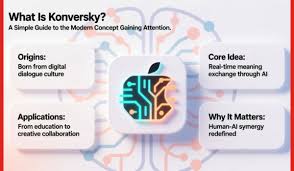
In today’s fast-moving digital economy, the way companies communicate with users has become just as important as the products they build. This is where konversky enters the conversation—not just as a keyword, but as a concept that reflects a broader shift toward intelligent, conversational, and highly adaptive digital systems. Whether you are a startup founder shaping your first product or a tech professional optimizing user engagement flows, konversky represents a mindset shift in how digital interaction is designed and scaled.
At its core, konversky is often associated with the evolution of conversational ecosystems—where communication between humans and machines is no longer linear, static, or scripted. Instead, it becomes dynamic, context-aware, and deeply personalized. In practical terms, this shift is redefining how businesses acquire customers, support users, and build long-term engagement loops that feel natural rather than forced.
Understanding Konversky in a Modern Digital Context
To understand konversky, it helps to step back and look at how digital communication has evolved over the last decade. Businesses once relied heavily on static websites, email funnels, and manual customer support systems. Then came chatbots, automation tools, and AI-driven assistants. But even these systems often lacked depth—they could respond, but not truly understand.
Konversky, as a conceptual framework, sits at the intersection of conversational AI, behavioral analytics, and adaptive UX design. It represents systems that not only respond to users but evolve with them. In this sense, konversky is less about a single tool and more about a layered architecture of interaction intelligence.
For startups, this matters because user expectations have changed dramatically. People no longer want to “navigate” digital systems—they want to talk to them, ask questions, and receive meaningful, contextual responses instantly.
Why Konversky Matters for Startup Founders
For entrepreneurs building in competitive markets, attention is the most expensive currency. Konversky-like systems help reduce friction in how users engage with digital products. Instead of forcing users through rigid funnels, these systems create fluid, conversational pathways that feel more human.
Imagine a SaaS onboarding experience where instead of reading documentation, a user simply asks, “How do I integrate this with my CRM?” and receives a tailored, step-by-step explanation based on their actual setup. That is the kind of experience konversky aims to enable.
Startups adopting this approach often see improvements in three critical areas: user retention, conversion rates, and support efficiency. But beyond metrics, there is a deeper shift happening—brands begin to feel more responsive, more intelligent, and more aligned with user intent.
Core Components of Konversky Systems
While konversky is an evolving concept, it can be broken down into several functional layers that define how it operates in practice. These layers help bridge the gap between abstract idea and real-world implementation.
| Layer | Description | Business Impact |
| Conversational Engine | Interprets user input in natural language and generates context-aware responses | Improves engagement and reduces drop-off rates |
| Behavioral Mapping | Tracks user intent, patterns, and journey signals | Enables personalization at scale |
| Adaptive Learning System | Continuously improves responses based on user interactions | Enhances accuracy and relevance over time |
| Integration Layer | Connects with CRM, APIs, and external data sources | Creates seamless workflows across platforms |
| Experience Orchestration | Controls how conversations are structured across channels | Ensures consistent brand interaction |
What makes konversky particularly interesting is not any single layer, but how these layers work together. Instead of isolated tools, businesses begin to operate within a unified conversational ecosystem.
Konversky and the Shift Toward Conversational Business Models
One of the most significant implications of konversky is its impact on business models themselves. Traditionally, digital products were built around navigation-based interaction—clicks, menus, and forms. But conversational systems are reshaping that foundation.
In a konversky-driven environment, the product interface becomes secondary to the conversation itself. Users do not need to learn how to use the system; they simply interact with it in natural language.
This shift has profound implications for industries like e-commerce, fintech, healthcare, and SaaS. For example, in e-commerce, instead of browsing filters, a customer might say, “Show me affordable running shoes for flat feet under $100,” and receive curated, personalized options instantly.
In fintech, users can ask complex financial questions and receive explanations tailored to their portfolio. In healthcare, patients can describe symptoms conversationally and be guided toward appropriate care pathways.
Real-World Applications of Konversky Principles
Although konversky is still an evolving idea, its principles are already visible in several real-world applications across industries.
In customer support systems, companies are moving away from static FAQ pages toward intelligent conversational assistants. These assistants do not just retrieve answers—they interpret intent and guide users through resolution paths.
In marketing automation, konversky-inspired systems are being used to create personalized campaign journeys. Instead of sending the same email sequence to all users, businesses now design adaptive flows that change based on user behavior in real time.
In product onboarding, SaaS platforms are increasingly using conversational walkthroughs that replace traditional tutorials. These systems allow users to learn by asking questions instead of reading manuals.
In enterprise environments, internal knowledge bases are being transformed into conversational interfaces, allowing employees to retrieve information instantly without searching through documentation.
The Challenges of Implementing Konversky Systems
Despite its advantages, implementing konversky-style systems is not without challenges. One of the biggest issues is data quality. Conversational intelligence depends heavily on structured, well-labeled, and context-rich data. Without it, systems can become inconsistent or unreliable.
Another challenge is maintaining balance between automation and human oversight. While konversky systems aim to reduce human intervention, completely removing it can lead to gaps in nuanced decision-making.
Privacy and data governance also play a critical role. Since these systems often rely on behavioral tracking and interaction history, companies must ensure compliance with data protection standards and ethical usage frameworks.
Finally, there is the challenge of user trust. Even the most advanced conversational systems must feel transparent and predictable. If users feel they are interacting with a “black box,” engagement can decline quickly.
Konversky and the Future of Digital Interaction
Looking ahead, konversky represents a broader movement toward ambient computing—where digital systems are always available, context-aware, and minimally intrusive. Instead of requiring users to adapt to software, software adapts to users.
We are likely to see konversky-inspired systems becoming deeply embedded into operating systems, business platforms, and even physical environments. Voice interfaces, multimodal AI systems, and predictive assistants will all contribute to this shift.
For startups, this opens a significant opportunity. Early adopters of conversational-first architecture will likely gain a competitive advantage in user experience design. As expectations evolve, static interfaces may begin to feel outdated compared to fluid, conversational ecosystems.
At the same time, the role of designers, developers, and product managers will also evolve. Building digital products will increasingly require a hybrid skill set that combines UX design, AI literacy, and behavioral psychology.
Strategic Takeaways for Entrepreneurs
For founders evaluating whether konversky-like systems are relevant to their business, the key question is not whether to adopt conversational technology, but how deeply it should be integrated into the user experience.
In some cases, it may be enough to enhance customer support with intelligent chat systems. In others, the entire product interface may need to be reimagined around conversational interaction.
What remains consistent is the underlying principle: users value speed, clarity, and personalization. Konversky simply provides a framework for delivering all three at scale.
Conclusion
Konversky is more than a buzzword—it reflects a fundamental transformation in how digital systems are designed, experienced, and scaled. As businesses move toward more intelligent and adaptive interfaces, conversational ecosystems will become central to how value is delivered online.
For startups and tech professionals, the opportunity lies not just in adopting new tools, but in rethinking interaction itself. Those who understand this shift early will be better positioned to build products that feel less like software—and more like conversations.