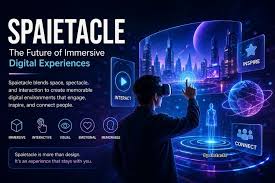
In today’s hyper-connected world, attention is the new currency, and capturing it has become harder than ever. This is where spaietacle enters the conversation—a concept reshaping how brands, startups, and digital creators design experiences that people don’t just see, but feel and remember. The rise of spaietacle signals a shift from passive content consumption to deeply immersive digital engagement that blends storytelling, technology, and emotion into a unified experience.
For startup founders and tech professionals navigating crowded markets, spaietacle is not just another buzzword. It represents a new strategic layer in digital experience design where engagement is engineered through spectacle-like immersion, often combining augmented reality, artificial intelligence, spatial computing, and narrative-driven interaction.
At its core, spaietacle is about transforming ordinary digital interactions into extraordinary moments that hold attention long enough to create impact.
Understanding Spaietacle in the Modern Digital Landscape
To understand spaietacle, it helps to break away from traditional thinking about digital content. For years, businesses relied on websites, ads, and social media posts to communicate value. But audiences have evolved. They no longer respond to static messaging—they respond to experiences.
Spaietacle is the evolution of that experience economy. It refers to a digitally engineered spectacle that merges spatial design, interactive storytelling, and sensory engagement. Unlike traditional media, which is linear, spaietacle environments are dynamic. Users influence what they see, hear, and interact with, making each journey unique.
In practical terms, imagine launching a product not with a press release, but with a virtual world where users can explore its features, interact with its story, and experience its value firsthand. That is spaietacle in action.
For entrepreneurs, this shift is significant because it redefines how products are introduced and how brands are remembered.
Why Spaietacle Matters for Startups and Tech Companies
Modern startups operate in an attention-scarce environment. Even the most innovative ideas struggle to stand out without compelling presentation. Spaietacle offers a solution by turning communication into experience.
Instead of telling users why a product matters, spaietacle lets them experience it. This approach dramatically increases emotional engagement and retention. Neuroscience supports this idea—people remember experiences far better than information alone.
From a business perspective, spaietacle also improves conversion rates. When users are immersed in a narrative-driven environment, their decision-making becomes more intuitive and emotionally driven rather than purely analytical.
For tech companies working with AI, AR, or spatial computing, spaietacle becomes even more relevant. It acts as the bridge between complex technology and human understanding.
The Core Elements That Define Spaietacle
Although spaietacle is a relatively new concept, it is built on several established technological and creative pillars. These elements work together to create immersive experiences that feel seamless and engaging.
| Element | Description | Business Impact |
| Spatial Computing | Digital environments that respond to physical space | Enhances user immersion and realism |
| Augmented Reality | Overlaying digital content on the real world | Improves product visualization |
| Artificial Intelligence | Personalizing experiences in real time | Increases engagement and relevance |
| Narrative Design | Story-driven interaction flows | Strengthens emotional connection |
| Interactive Media | User-driven exploration and control | Boosts retention and participation |
Each of these components contributes to the larger ecosystem of spaietacle, making it more than just a visual experience—it becomes a full sensory journey.
How Spaietacle is Changing Digital Storytelling
Traditional storytelling in marketing follows a simple structure: problem, solution, and call to action. Spaietacle disrupts this model by removing linear constraints and replacing them with exploratory narratives.
Instead of guiding users step-by-step, brands create environments where users discover stories at their own pace. This shift transforms audiences from passive viewers into active participants.
For example, a SaaS company might build a spaietacle experience where users navigate a virtual office showing real-time data flows, AI automation systems, and customer journeys. Rather than reading about features, they interact with them.
This method not only improves comprehension but also builds trust. When users experience value firsthand, skepticism decreases naturally.
The Technology Behind Spaietacle
Behind every spaietacle experience is a powerful combination of emerging technologies. These systems work together to create seamless and responsive environments.
Artificial intelligence plays a central role by adapting content in real time based on user behavior. Meanwhile, AR and VR technologies provide the visual and spatial layer that makes the experience feel tangible. Cloud computing ensures scalability, allowing thousands or even millions of users to engage simultaneously without performance loss.
Another critical component is real-time rendering engines, which enable high-quality interactive visuals without delay. These engines are essential for maintaining immersion, as even slight lag can break the experience.
Together, these technologies form the backbone of spaietacle ecosystems, making them both scalable and highly adaptive.
Real-World Applications of Spaietacle
Although still emerging, spaietacle is already influencing multiple industries. In marketing, it is used to create immersive product launches. In education, it transforms learning into interactive exploration. In entertainment, it powers next-generation virtual concerts and digital events.
Startups are particularly well-positioned to adopt spaietacle because they are more flexible and open to experimentation. A fintech startup, for example, could use spaietacle to visually simulate investment outcomes, helping users understand complex financial decisions more intuitively.
Similarly, e-commerce brands can build virtual shopping environments where customers interact with products before purchasing, reducing uncertainty and increasing confidence.
The Business Value of Spaietacle
The most important question for any founder is simple: what is the return?
Spaietacle delivers value in several key areas. First, it increases user engagement by making interactions more meaningful and less passive. Second, it improves brand recall by embedding messages within experiences rather than advertisements. Third, it enhances conversion rates by reducing friction in the decision-making process.
Perhaps most importantly, spaietacle creates differentiation. In saturated markets where products often look similar, experience becomes the deciding factor.
Companies that invest early in spaietacle strategies position themselves as innovators rather than followers. This perception alone can significantly influence investor interest and customer trust.
Challenges in Implementing Spaietacle
Despite its advantages, spaietacle is not without challenges. The most obvious barrier is cost. Building immersive environments requires advanced technical expertise and resources that not all companies possess.
Another challenge is user accessibility. Not all audiences are equipped with devices capable of supporting high-end immersive experiences. This can limit reach if not carefully designed.
There is also the challenge of balancing complexity with usability. While spaietacle thrives on depth and interaction, overcomplicating the experience can overwhelm users and reduce effectiveness.
Successful implementation requires a thoughtful balance between innovation and simplicity.
The Future of Spaietacle in Digital Innovation
As technology continues to evolve, spaietacle is expected to become more mainstream. With the rise of spatial computing devices, AI-driven personalization, and immersive web technologies, the boundaries between physical and digital experiences will continue to blur.
In the near future, websites may no longer be static pages but fully interactive environments. Marketing campaigns may become virtual worlds. Product demonstrations may feel like real-world experiences.
For startups and enterprises alike, this means one thing: the way we design digital experiences is fundamentally changing.
Spaietacle is not just a trend—it is a preview of how digital interaction will evolve over the next decade.
Conclusion
Spaietacle represents a major shift in how businesses communicate, engage, and convert audiences in the digital age. By blending immersive technology with storytelling and interaction, it transforms passive viewing into active participation.
For startup founders and tech professionals, embracing spaietacle is not just about staying ahead of trends—it is about redefining how value is experienced in a digital-first world. As competition for attention continues to intensify, those who invest in immersive experience design will be the ones who stand out.
The future of digital engagement is not just visual. It is experiential, interactive, and deeply human. And spaietacle sits at the center of that transformation.